I Built Something That Used to Cost My Clients Thousands. Then I Made It Free.
A few weeks ago I sat down at my desk with a question that had been nagging me for months: why does it cost so much for a New Zealand business to find out where they stand with AI?
I've run maturity assessments for clients as part of larger engagements. They're valuable. They give leadership teams a shared language, a baseline, and a starting point for real conversations about where to invest. But they've always been locked behind consulting fees. A proper assessment, grounded in research and tailored to context, isn't something most small and mid-sized organisations can justify spending thousands on. Not when they're still trying to figure out whether AI is even relevant to them yet.
That felt like a problem worth solving.
The gap
The numbers tell a clear story. 91% of New Zealand AI adopters report efficiency gains. But only 12% have scaled AI across their organisation. That's not a technology gap. It's a clarity gap. Most businesses know AI matters. Far fewer know where they actually stand, or where to focus first.
I've seen this play out in workshops and boardrooms across the country. Leaders who are curious but overwhelmed. Teams who've experimented with ChatGPT but have no strategy behind it. Boards asking for an AI roadmap when the organisation hasn't even assessed its own readiness.
The first step is always the same: understand where you are right now.
Building Compass
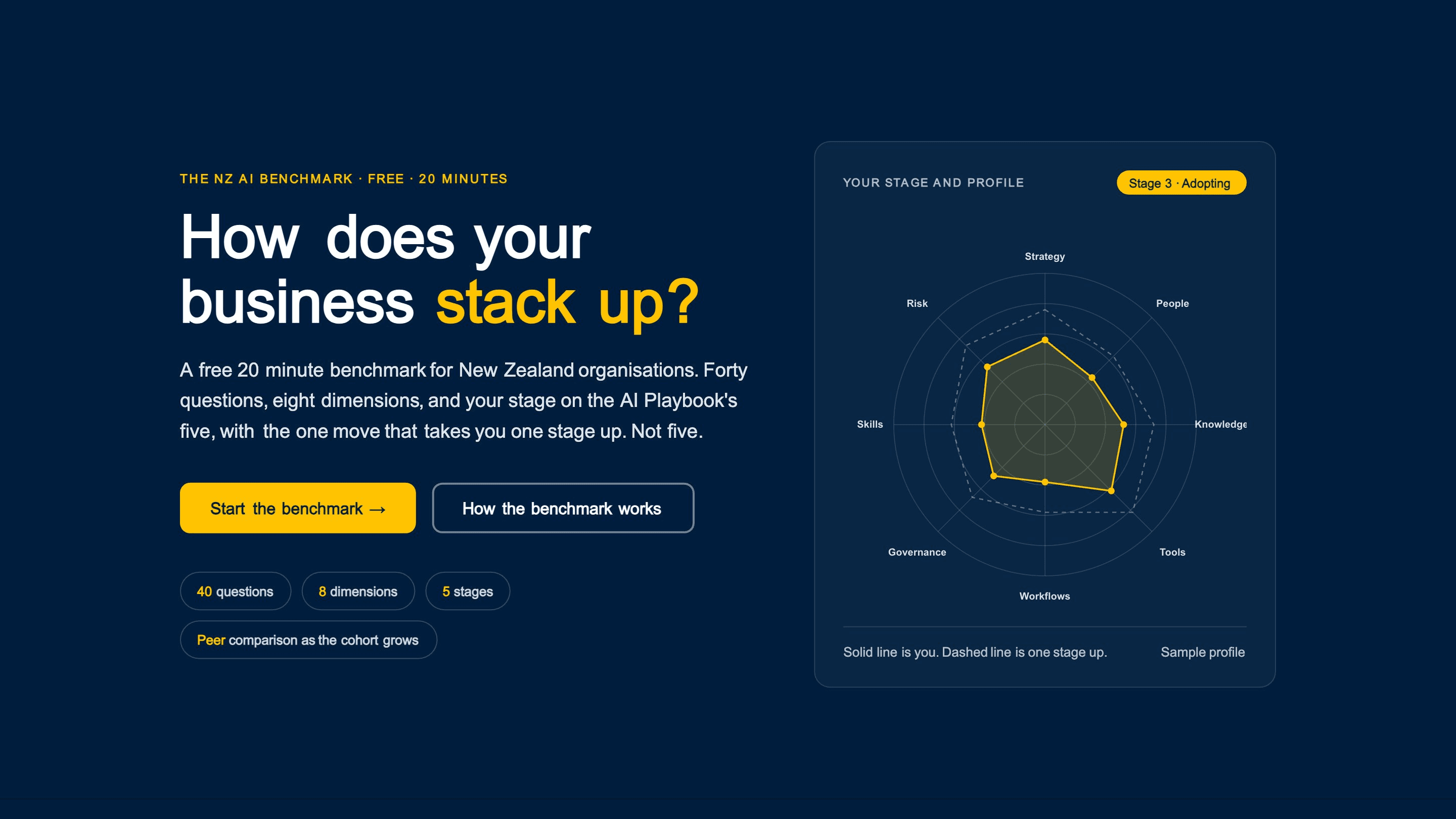
Cairn Compass is a free AI maturity assessment built specifically for New Zealand organisations. 40 questions, about 15 minutes, and you get a clear picture of where you stand across eight dimensions: strategy, leadership, data, technology, people, process, culture, and governance.
It's grounded in NZ and international AI research, drawing on publications from some of the leading researchers and organisations in this space. It maps your organisation against five levels of maturity, from Aware through to Transforming.
The results are immediate. No sign-up required. You get a radar chart showing your profile across all eight dimensions, your overall maturity level, your top three strengths, your priority gaps, and how you compare against New Zealand benchmarks.
If you want to go deeper, hand over your email and you'll receive a full personalised report with commentary across every dimension and prioritised recommendations for what to focus on next.
Built with the tools we teach
Here's the part I find pretty compelling. Compass was built using the same AI tools we help our clients adopt. Claude did a significant amount of the heavy lifting, from research synthesis to content generation to helping shape the assessment framework itself.
A few years ago, building something like this would have required a dedicated team and a significant budget. Today, a consultant with the right tools and domain knowledge can build a research-backed, professionally delivered assessment tool in weeks. That's not hype. That's the reality of what these tools make possible when you use them with intention.
It felt important to practise what we preach. If we're telling New Zealand businesses that AI can help them do more with less, we should be demonstrating that ourselves.
Why it matters for NZ
New Zealand has a unique AI adoption profile. We're a small, pragmatic market. We don't have the luxury of throwing millions at speculative AI programmes, but we also can't afford to sit on the sidelines while the rest of the world moves. The organisations that will thrive are the ones that start with a clear understanding of their own readiness, then make deliberate, well-sequenced investments.
That's what Compass is designed to help with. Not a sales pitch dressed up as an assessment. A genuine tool that gives you useful information, whether or not you ever talk to us.
Give it a go
You can take the assessment at compass.cairn.nz. It's free, it's fast, and you might be surprised by what your radar chart reveals.
I'd love to hear what you think.