High-use, low-trust: what the new AI Blueprint really means for New Zealand business
Last week the AI Forum NZ released the third edition of the AI Blueprint for Aotearoa. It’s the document the country’s AI ecosystem points to when it wants to say where we are and where we’re going. On Thursday I sat down with my bowl of porridge and dissected it properly, trying to work out what it really means for NZ business. One phrase stuck.
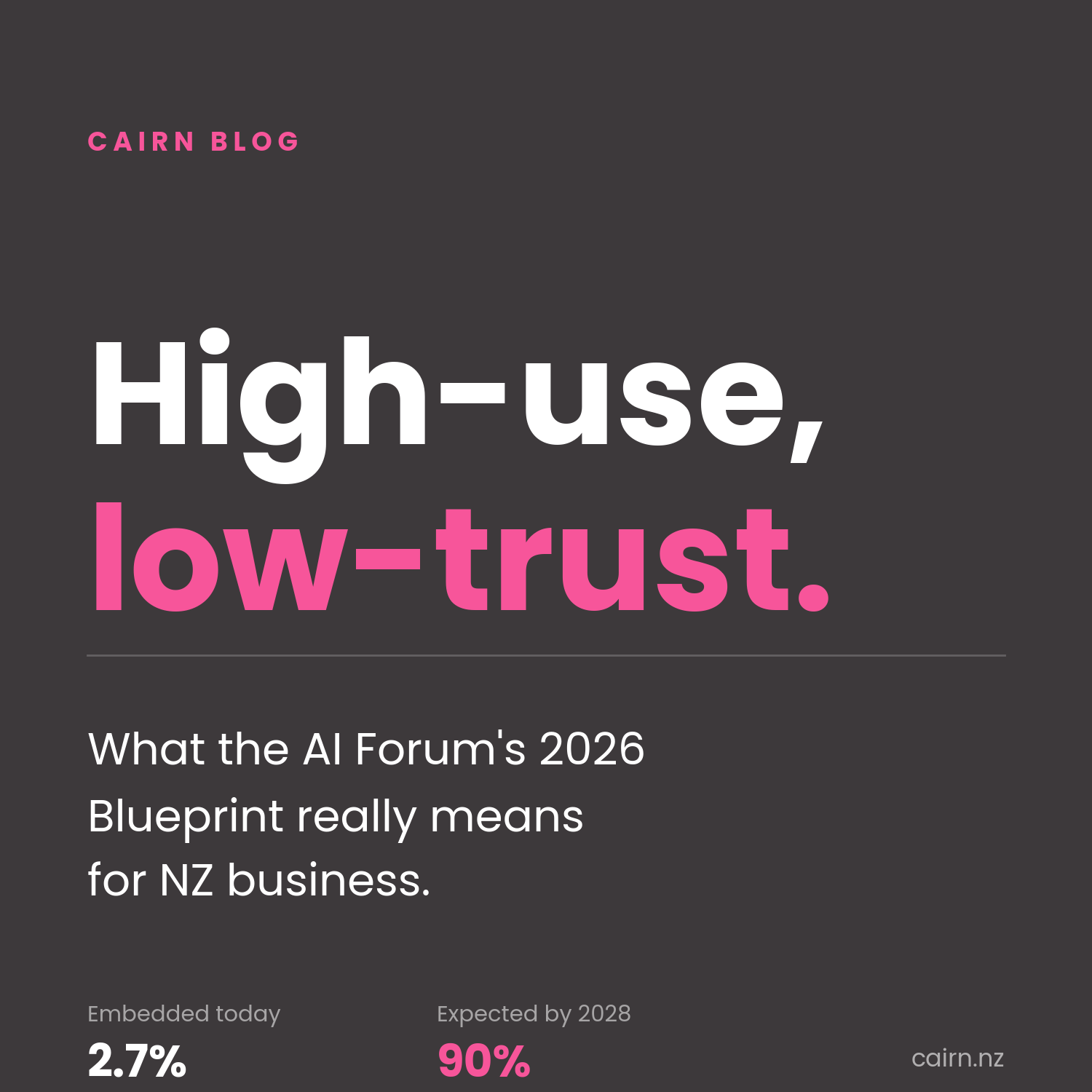
High-use, low-trust.
That’s the Forum’s read of where New Zealand has actually landed with AI in 2026. Adoption is running somewhere between 40 and 80 percent depending on how you measure it. Self-reported productivity gains are real and consistent. But trust has not moved. Not in the public, not in boardrooms, not even among the people already using the tools every day.
That gap is the whole story.
The four figures that surprised me
Four statistics in the Blueprint stopped me mid-spoon:
-
2.7% of the NZ workforce qualify as AI practitioners with AI embedded in their workflows.
-
97% are using AI superficially or not at all.
-
79% of NZ employers don't know how to implement an AI workforce training programme.
-
90% of those same employers expect to be using AI-powered solutions by 2028.
[caption id="" align="alignnone" width="3679"]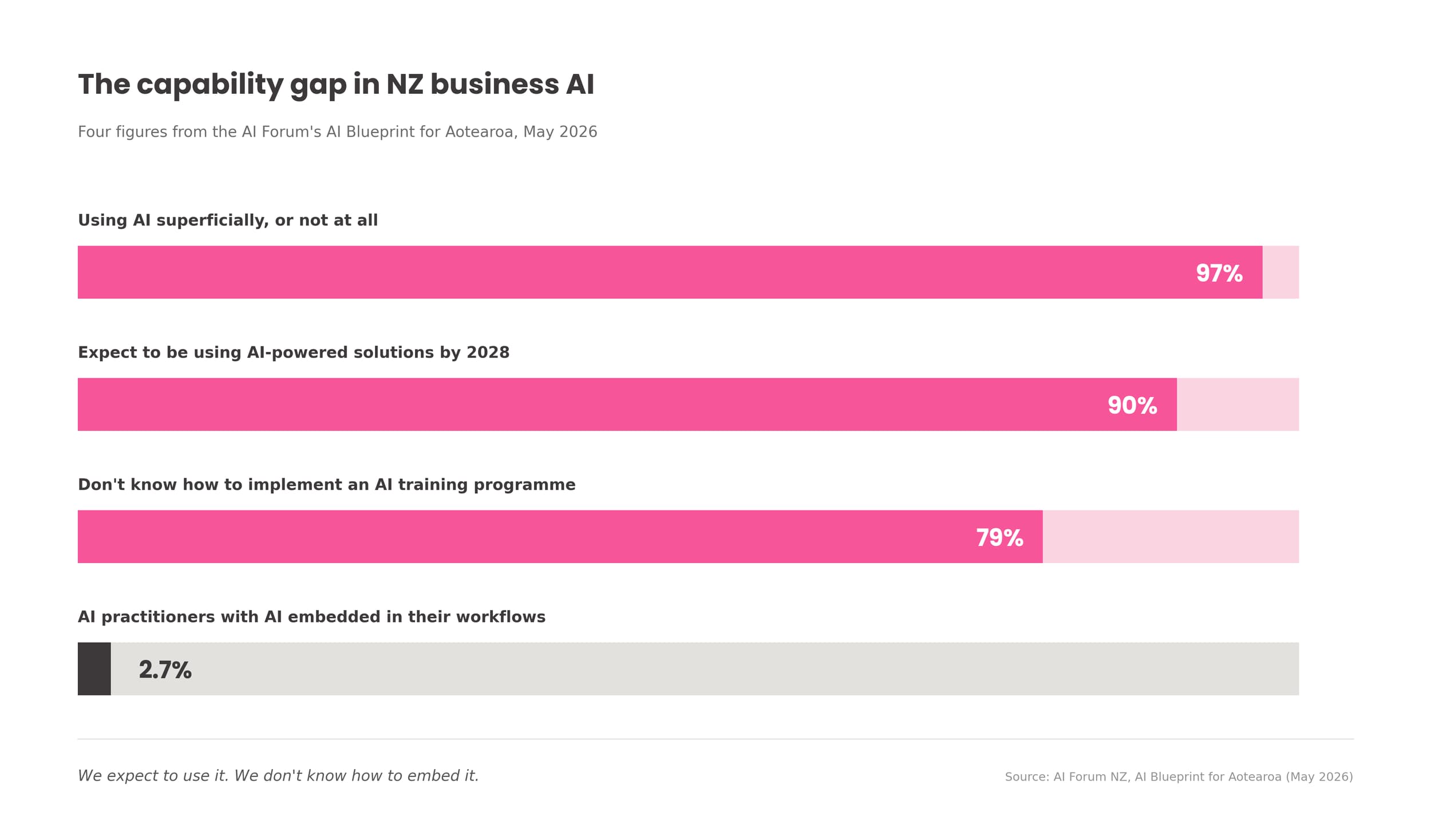 The capability gap in NZ business AI [/caption]
Put those together and you've got the actual NZ AI conversation in 2026. Lots of people poking at the tools. Very few using them well. Almost nobody confident in how to train their team. And a hard deadline most of them haven't named yet.
The Blueprint's own line on what fixes this is the clearest sentence in the document, and worth quoting in full:
The next phase of AI adoption won't be determined by access to technology alone. It will be shaped by how well organisations, government, and society address trust, skills, and governance alongside continued use.
Read that twice. The Forum is saying out loud what those of us working with NZ businesses every week have been seeing for a year. The tech is sorted. The rest isn't.
People, process, technology
The lens I've always used when sizing up an AI engagement is the old people-process-technology stack. The Blueprint, in effect, is saying we've solved one third of the problem.
The technology is here. Copilot, Claude, agentic capabilities. They already work. What's missing is the human side: the processes, the capability, the governance, the confidence. That's where every successful adoption effort has to put its weight in 2026.
If 79% of employers honestly don't know how to train their team, that's a process and capability gap, not a technology one. If trust hasn't moved despite high use, that's a governance and people gap, not a technology one. Buying more licences won't close either. Doing the people and process work will.
Why we've refreshed Cairn Compass
That's the lens I've used to refresh Cairn Compass this week.
For anyone who hasn't come across it, Compass is our free AI maturity assessment for New Zealand organisations. Forty questions, about 20 minutes, no sign-up needed to see your results. It maps your organisation across eight dimensions (strategy and leadership, people and culture, data, technology, process, governance, training and capability, and NZ regulatory readiness) and tells you where you actually stand, not where you'd like to be.
Two things have changed in this refresh.
The questions are tighter. I've rewritten the question set to reflect the realities the Blueprint surfaces. The new questions probe trust, governance, and capability-building specifically, not just "have you tried Copilot." If 79% of NZ employers honestly don't know how to train their team, the assessment needs to ask the same question honestly back, and give you something useful to work with when the answer is "we don't."
The output is more useful. The results page now ties what you see to the Blueprint's framings: where you sit relative to the high-use, low-trust pattern, where your capability gap is widest, and what to focus on first. Less generic, more grounded in the NZ picture.
That's it, really. Same shape, same free assessment. Calibrated to the conversation NZ business is actually having in 2026 instead of the one we were having a year ago.
What to do with it
The Blueprint sets a national ambition. Top 30 in the Government AI Readiness Index by 2030. Top 25 in the Global AI Index. To be honest, fairly modest targets, but worth meeting. The country won't get there by adoption alone. It gets there when individual organisations make deliberate moves: assess where they are, name where the trust and capability gaps actually sit, build the people side, and keep going.
That has to start with knowing where you stand. And the right answer for most organisations isn't a strategy document or a vendor demo. It's a clear, honest read of your own maturity, free of sales pressure, that gives you something concrete to act on.
If you've been meaning to get a baseline, now's a good time. Compass is at compass.cairn.nz. Free, about 20 minutes, and you'll walk away with a clearer picture of where your business sits and where to put your next dollar of AI effort.
The Blueprint won't read itself. Compass will help you act on what it says.