Stop Dabbling: The AI Muscle Gap Holding Back New Zealand Organisations
New Zealand's AI journey is not primarily a technology story. It is a maturity story, and an increasingly urgent one.
The tools are racing ahead. Most organisations are not. Across hundreds of conversations with individuals and businesses throughout the country, and informed by recent research into how AI supports complex problem-solving and organisational knowing, a clear pattern has emerged: we already have access to world class AI models, but only a small minority are building the organisational muscles to use them wisely, safely, and distinctively.
What follows is a concise look at the most important dimensions of AI maturity in the New Zealand context, and the divide that is opening up between those who dabble and those who operationalise.
1. Most Kiwi Organisations Are Still AI-Immature
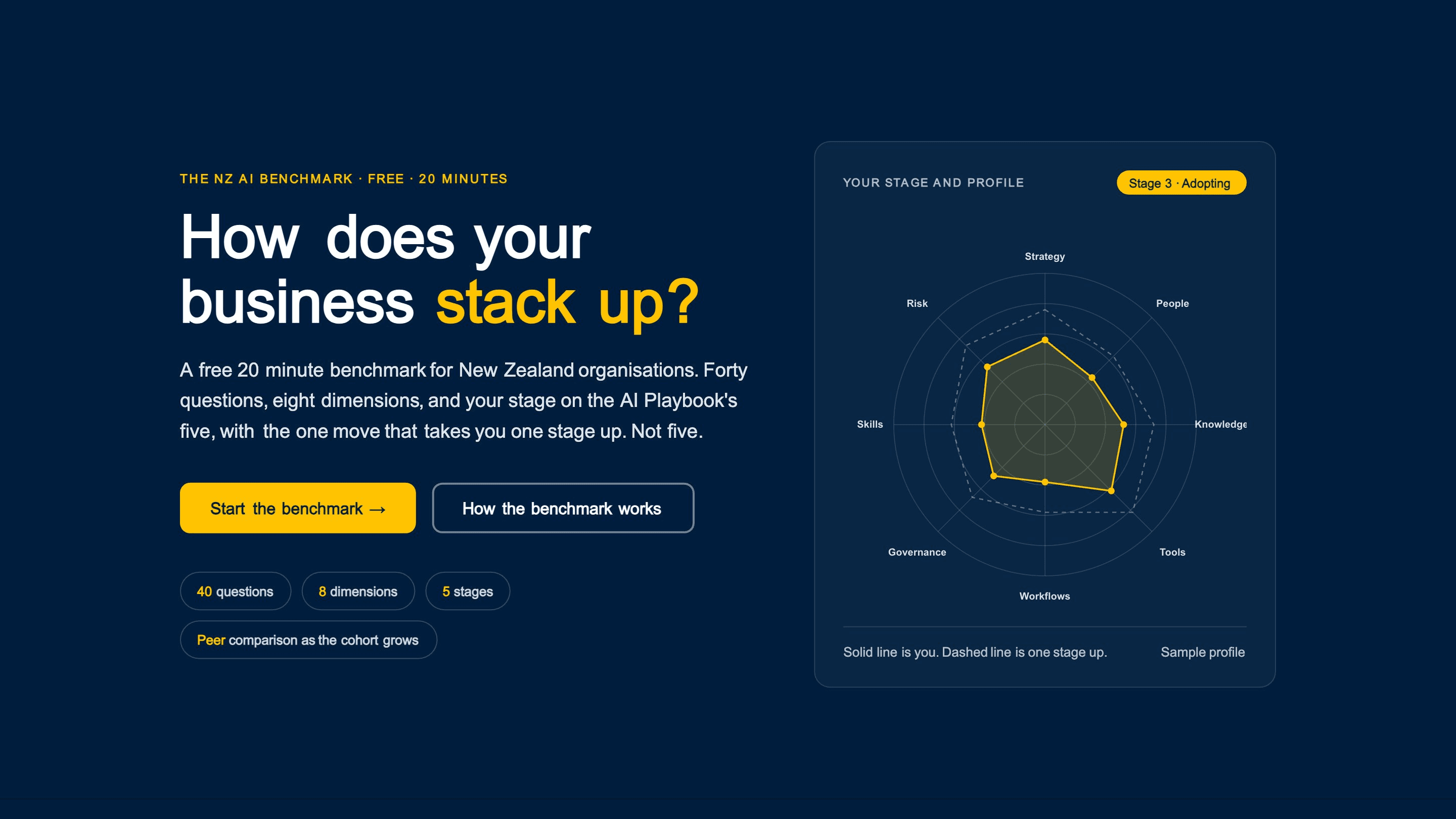
Beneath the hype, AI maturity in New Zealand clusters at the bottom of the curve.
Among larger organisations, around two thirds now report using some form of AI, up sharply over the last few years. For small and medium enterprises, the picture is very different. Around 68 percent report they have no plans to evaluate or invest in AI at all.
From the ground, this looks like:
-
Level 0–1: Ad hoc and fragile
No AI strategy, minimal or no governance, and experiments that live in the heads of a few enthusiasts. When those people move on, the capability disappears with them. -
Level 2: Emerging structure
Tools such as Copilot and ChatGPT are available, there are pockets of usage, but AI is not embedded into core workflows. Training is thin, and there is no shared view of what “good” looks like.
Very few organisations have moved into the stages where AI is supported by shared infrastructure, clear governance and leadership sponsorship, and treated as an ongoing organisational capability rather than a one off initiative.
More organisations are now starting. Very few are yet reshaping their operating model or identity through AI.
2. The Hard Problems Are Human and Structural, Not Technical
The main adoption barriers are not about models or compute. They are about people, process, and the particular shape of New Zealand business.
Micro businesses and family ownership
New Zealand is a nation of very small firms. Approximately 97 percent of businesses have fewer than 20 employees, around 70 percent are sole traders, and roughly 90 percent have five or fewer staff. A significant share are family owned, with most equity held by family shareholders.
That structure tends to create:
-
Strong relationships, community roots, and long term thinking
-
Reasonable basic technology
-
Weakly documented processes and informal governance
Work often lives in people’s heads and in personal networks, not in systems or process maps. Without a clear view of how work actually gets done today, it is extremely hard to safely redesign that work with AI.
Fear, trust, and understanding
New Zealanders are more anxious about AI than most. International surveys place New Zealand near the top of the league table for concern about AI products and services. Only around 44 percent of people believe AI’s benefits will outweigh its risks.
For many, “AI” still means deepfakes and job loss. Without a basic mental model of how modern AI works, risks can feel unbounded, and the default response is often either avoidance or blind trust, rather than deliberate, governed adoption.
Training treated as optional
Too often, organisations roll out AI tools as if they are a minor software upgrade, then hope that people will “pick it up”.
In reality, using AI well requires:
-
Understanding what these systems are good and bad at
-
Providing rich context and clear constraints
-
Asking structured questions
-
Critically testing and refining outputs
Setup costs are no longer the barrier they once were. Three quarters of organisations now report AI implementation costs under $5,000, compared to nearly one third spending more than $50,000 in earlier years. The gap is not tools. It is capability, confidence, and leadership commitment.
3. From Oracle To Copilot To Strategic Peer
The way New Zealanders relate to AI is shifting through three broad stages. Each stage brings different risks and opportunities.
Oracle
At this stage, AI is treated as an all knowing source of truth.
-
One question in, one answer out, taken at face value
-
Little sense of bias, probability, or cultural and geographic blind spots
-
Limited iteration or challenge
The risk here is over trust in a single, homogenised answer that may not fit local context or minority perspectives.
Copilot or assistant
With more experience, AI becomes a productivity partner.
-
People start to provide background, constraints, and examples
-
AI helps structure thinking, generate options, and draft content
-
There is a back and forth conversation rather than a single query
This is where most active New Zealand users now sit. The key enabler is treating AI like an intelligent colleague, not a search box. Subject matter expertise and good prompting bring far better results than generic questions.
Critical thinking and what might be called a “teacher mindset” become important here: starting with the outcome in mind, clearly describing what a good answer looks like, and interrogating outputs rather than accepting the first response.
Emerging peer or agent
In more mature environments, AI starts to operate as another “seat at the table” in defined workflows.
-
Agents are given specific roles, such as analysis, triage, or decision support
-
Multiple agents may provide different perspectives, for example by market or scenario
-
Humans remain accountable, but AI is an active participant
This is where the relationship between people and AI becomes most interesting, and where human capability makes the greatest difference. At the expert end of the spectrum, such as analytics and research, people tend to see AI as an amplifier. At the customer service end, where work is more visible and routine, there is much more anxiety about job loss. In some surveys, around 14 percent of organisations already attribute job losses directly to AI, with nearly half reporting reduced hiring needs.
The maturity shift here is recognising both realities. AI can amplify expertise and also displace certain tasks. The organisations that navigate this well are explicit about where AI sits in the workflow, what decisions remain human, and how roles and skills will evolve.
4. Automation First, Then AI
A consistent pattern in New Zealand is the urge to “do AI” before understanding and simplifying the underlying work.
Often, the higher value sequence is:
-
Map the work
Get clear on how tasks actually flow across people, systems, and customers. Make the tacit explicit. -
Automate the obvious
Remove simple, repetitive, rule based steps that do not require intelligence. -
Then layer in AI
Bring AI into the redesigned workflow where it can genuinely amplify human judgement, not just patch over broken processes.
A simple customer service example illustrates the point. Some retailers and telcos are now using retrieval augmented chatbots that answer routine questions from a single maintained source of truth, and route complex or sensitive cases to humans. The value comes less from the chatbot itself, and more from:
-
A well structured knowledge base
-
Clear rules about what is handled by AI and what is escalated
-
Thoughtful design of handover between agent and human
Without that process design and automation groundwork, the same AI technology would produce inconsistent answers, poor customer experiences, and new risks.
For New Zealand’s micro and small businesses, which often rely on unwritten, person dependent processes, this sequencing is critical. Trying to “AI transform” an undocumented, ad hoc workflow usually creates noise, not value.
5. Governance, Identity, and Human in the Loop
As AI moves from peripheral tool into core decision-making, new questions emerge that go beyond technology.
Some of the most important are:
-
What role should AI play in strategic conversations, such as scenario analysis, competitive intelligence, or risk modelling?
-
Who is accountable for decisions that rely on AI generated insight?
-
How do we ensure AI use aligns with our identity, values, and obligations to staff, customers, and communities?
For family and owner operated businesses in particular, where reputation and relationships carry real weight, these are not abstract questions. Organisations are rightly asking whether using AI in customer facing and decision making roles strengthens or weakens what they stand for.
Responsible AI guidance for New Zealand businesses emphasises transparency, fairness, accountability, privacy, and respect for New Zealand values, including te ao Māori perspectives. In practice, maturing organisations are starting to:
-
Give AI a clear executive owner or sponsor
-
Put in place proportionate governance and guardrails
-
Bring together cross functional voices, not just technology teams
-
Invest in training so people understand both the power and the limits of these systems
This is where the questions about AI become a practical call to action.
If you are part of a New Zealand leadership team, useful starting questions include:
-
Where, specifically, do we want AI to sit in our decision flows, and where must people remain clearly in charge?
-
What are the few, concrete guardrails we need to put around AI use to align with our values and obligations?
-
How will we build the skills and confidence our people need to treat AI as a capable assistant or peer, not an oracle or a threat?
6. The Real Divide: Dabblers Versus Operationalisers
Most New Zealand organisations now interact with AI in some form. The divide is no longer between users and non users. It is between those who dabble and those who operationalise.
Dabblers
Use of AI - Scattered experiments, a few licences, personality driven
Processes - Little or no documentation, AI layered over chaos
Governance - No clear owner, minimal policy
Training - Enthusiasts self teach, most left to figure it out
Measurement - Anecdotes about “saving time”
**
Operationalisers**
Use of AI - Clear roadmap, AI aligned to strategy and workflows
Processes - Processes mapped, simplified, automated, then augmented
Governance - Named executive sponsor, simple guardrails, regular review
Training - Structured, role based training and support across teams
Measurement - Defined metrics, tracked impact, continuous improvement
The economic context makes this divide significant. Generative AI alone is projected to add around 76 billion dollars to New Zealand’s economy by 2038, equivalent to more than 15 percent of GDP. Early deployments in the public sector have already demonstrated returns on investment in the high triple digits. At the same time, labour productivity has lagged comparable economies for decades, with GDP per hour worked around 40 percent lower than some peers, and digital capability among small businesses remains patchy.
New Zealand will not compete on building foundational AI models. Government strategy is explicit that our advantage will lie in being sophisticated adopters, not primary inventors. That lines up with what is visible on the ground.
The opportunity is to combine:
-
Deep local and sector expertise
-
Well understood, well designed workflows
-
Thoughtful automation
-
Governed, well trained use of AI as copilot and peer
The question for each organisation is simple, but not always comfortable:
Are we building AI capability as part of how we work, or are we just collecting licences and dabbling at the edges?
The tools are here. The opportunity is measurable. The difference will be made by those who choose to build the muscles.
Ben Walker is the founder of Cairn, providing AI adoption services, technology strategy, and virtual CIO leadership to New Zealand businesses. With more than 25 years in technology, he works with organisations to build the maturity, governance, and capability needed to turn AI from hype into sustained competitive advantage.
Selected external resources mentioned
New Zealand Responsible AI Guidance for Businesses (MBIE)
https://www.mbie.govt.nz/assets/responsible-ai-guidance-for-businesses.pdf
New Zealand AI Strategy: Investing with Confidence (Beehive)
https://www.beehive.govt.nz/sites/default/files/2025-07/New%20Zealand's%20AI%20Strategy%20-%20Investing%20with%20confidence.pdf
Key Findings from New Zealand's Third AI Productivity Report (AI Forum NZ)
https://aiforum.org.nz/reports/ai-in-action-key-findings-from-new-zealands-third-ai-productivity-report/
Unlocking New Zealand's 3.4 billion dollar AI advantage (Microsoft)
https://news.microsoft.com/source/asia/features/nz-new-ai-economy-report-2025/
Understanding the Digital Capability of New Zealand Businesses (MBIE)
https://www.betterforbusiness.govt.nz/dmsdocument/17055-understanding-the-digital-capability-of-new-zealand-businesses
Defining Small Business in New Zealand (MBIE)
https://www.mbie.govt.nz/assets/defining-small-business.pdf
New Zealand's Productivity Challenge (IMF)
https://www.elibrary.imf.org/view/journals/018/2025/075/article-A001-en.xml