AI Adoption in New Zealand: The 2026 Data and a Practical Guide
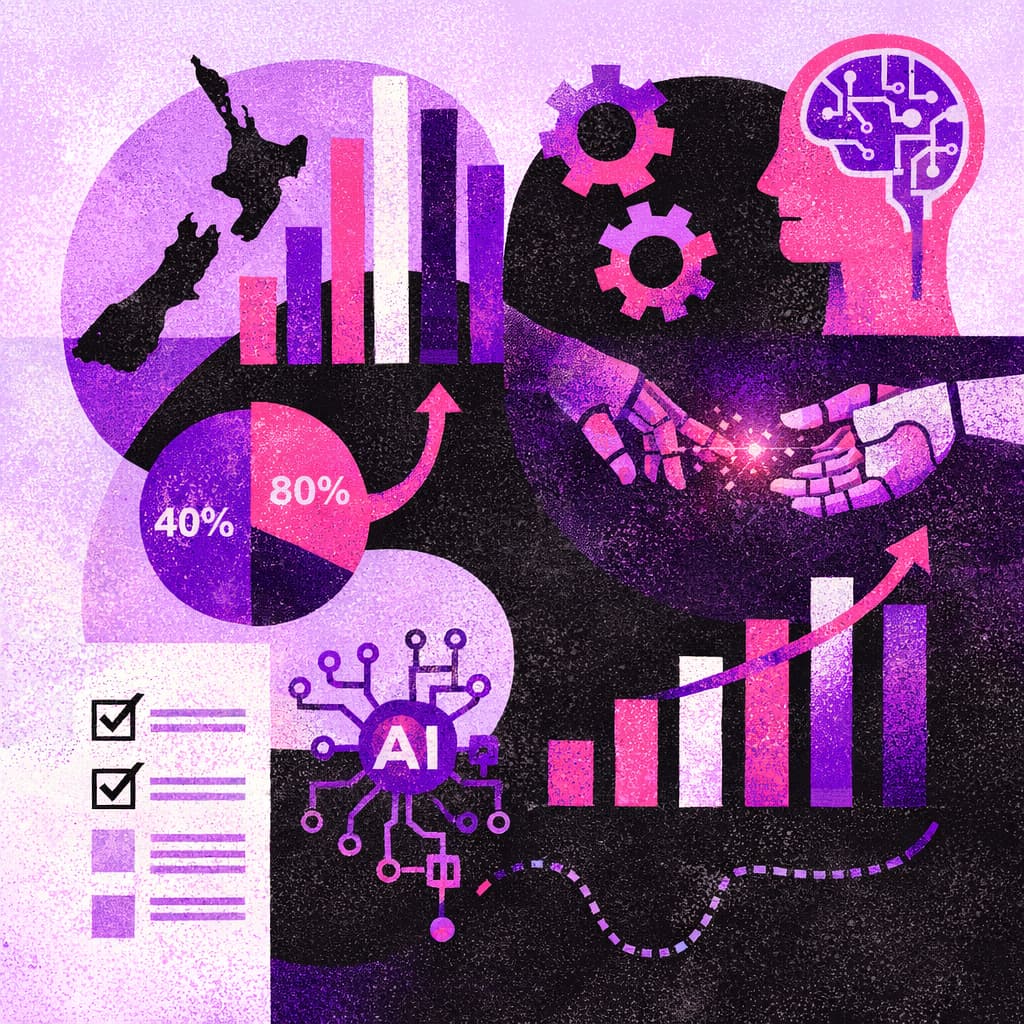
Most New Zealand organisations are further into AI usage than they think, and further behind on AI adoption than they realise. Usage is widespread: the AI Forum NZ puts uptake at 40 to 80 percent of organisations, and our own Cairn Compass data shows everyday AI use by staff is the single strongest signal in the assessment. But usage isn't adoption. The structure that turns usage into durable value, training, redesigned processes, governance and measurement, is where NZ organisations score lowest.
This guide covers what the 2026 data actually shows, why adoption efforts stall, and a practical six-step path for adopting AI in a New Zealand organisation. The numbers come from two sources: the AI Forum's AI Blueprint for Aotearoa (May 2026) and first-party results from Cairn Compass, our free AI maturity assessment for NZ organisations.
How widely is AI being used in New Zealand?
Between 40 and 80 percent of New Zealand organisations are using AI in 2026, depending on how usage is measured, according to the AI Forum NZ's review of 28 adoption studies. Productivity gains are consistently self-reported. But the same research shows only 2.7 percent of the NZ workforce qualify as AI practitioners with AI embedded in their workflows, which means around 97 percent are using AI superficially or not at all.
Two more figures complete the picture. 79 percent of NZ employers say they don't know how to implement an AI workforce training programme, and 90 percent expect to be using AI-powered solutions by 2028. Put plainly: nearly every NZ organisation expects to run on AI within two years, and four out of five don't know how to get their people ready for it.
The AI Forum's summary phrase for this is "high-use, low-trust". Lots of activity, not much confidence.
How mature are NZ organisations at AI?
The typical NZ organisation sits at the second of five AI maturity levels, "Experimenting", with a median score of 2.4 out of 5 in early Cairn Compass results. Pilots are underway and guidelines are forming, but most organisations assessed sit in the first two levels, and only a small handful score beyond level three.
Compass measures maturity across eight dimensions, five questions each, on a 1 to 5 scale. The five levels are:
-
Aware: AI's potential recognised, no coordinated activity
-
Experimenting: pilots underway, initial guidelines forming
-
Operational: AI integrated into specific functions with measurable outcomes
-
Scaling: enterprise-wide deployment with mature governance
-
Transforming: AI drives new business models
The early 2026 dimension averages (out of 5) tell the real story:
-
Data readiness: 2.9
-
Technology & infrastructure: 2.8
-
People & culture: 2.8
-
Strategy & leadership: 2.6
-
Process integration: 2.4
-
Governance & risk: 2.4
-
NZ regulatory & responsible AI: 2.4
-
Training & capability: 2.0
The pattern: the dimensions that come free with usage score well, and the ones that take deliberate work don't. The highest-scoring single question in the whole assessment is everyday AI use by staff (3.4 out of 5). The lowest-scoring dimension is training and capability (2.0), and it's the most common top gap. These results come mostly from chief executives and directors, the engaged ones, so the gaps across the wider market are likely wider still.
Why do AI adoption efforts stall?
AI adoption stalls when usage runs ahead of structure. Three specific patterns keep showing up in the Compass data:
Activity without accountability appears in 4 in 10 assessments. Teams use AI daily but nobody measures the impact, so there's no ROI evidence, no view of what's working, and no basis for the next investment decision. Without measurement, AI stays a collection of personal habits rather than a business capability.
Tools without process also appears in 4 in 10. AI tools sit alongside workflows instead of being built into them. People save minutes here and there while the underlying process stays exactly as it was. Most of the potential value goes uncaptured.
The compliance gap appears in 3 in 10. AI use matures faster than the organisation's understanding of how New Zealand law applies to it. That exposure grows as usage grows.
There's a fourth stall point the national data makes obvious: training that ends after one session. A single intro workshop lifts enthusiasm for a fortnight and changes nothing by week six. That's not a cynical observation, it's the reason 79 percent of employers say they don't know how to run an AI training programme. Most have only ever seen the one-off version.
How do you adopt AI in your organisation? A six-step approach
The short answer: baseline your maturity, set the ground rules, measure what's already happening, redesign one process, train as a programme, then scale what works. People and process first, technology second. Here's each step in practice.
1. Baseline your AI maturity. You can't navigate without knowing where you're standing. A structured maturity assessment shows which of your dimensions are strong, which are gaps, and which traps you've already walked into. Cairn Compass does this free for NZ organisations: 40 questions, about 20 minutes, results across all eight dimensions.
2. Write the ground rules. A short, written AI use policy: which tools are approved, what data can and can't go into them, when AI use should be disclosed, who's accountable. MBIE's Responsible AI Guidance for Businesses (July 2025) is the authoritative NZ starting point, and a practical policy is a one-to-two page document, not a legal project.
3. Measure what's already happening. Your people are already using AI, so find out where, and put numbers on it: time saved, errors avoided, turnaround improved. This closes the accountability trap and gives you the evidence base for every decision that follows.
4. Pick one process and redesign it. Not ten. Take a workflow people already use AI on informally and rebuild it properly, with the AI step designed in rather than bolted on. One process done well builds more momentum than any strategy document.
5. Train as a programme, not an event. Structured sessions tailored to roles, real use cases from your own work, a gap between sessions so people can practise, and someone accountable for keeping content current as the tools change. This is the difference between the 3.4 and the 2.0 in the data above.
6. Build internal champions and review quarterly. Capability has to live inside your organisation, not with a consultant. Two or three champions who collect use cases, support hesitant colleagues and feed a regular review cycle will keep adoption compounding after the formal programme ends.
What does AI adoption cost in New Zealand?
For most NZ organisations, structured AI adoption starts in the low thousands, not the hundreds of thousands. Entry points like a facilitated discovery workshop sit around $2,500. Independent AI consulting in New Zealand typically runs $200 to $350 per hour, and regional business support programmes can co-fund advisory work, in some cases up to 50 percent. The full breakdown, including how to evaluate consultants and what to expect from an engagement, is in our guide to AI consulting in New Zealand: what to expect in 2026.
The more useful framing than cost is sequence. Most NZ businesses don't need custom AI at all. The right first spend is almost always better use of tools you already own, Microsoft 365 Copilot or Claude, wrapped in the process and training work above.
What New Zealand laws apply to AI?
New Zealand has no AI-specific legislation as of mid-2026, and the government has deliberately taken a light-touch, principles-based approach. Existing law applies in full: the Privacy Act 2020 governs personal information entering AI tools, the Fair Trading Act covers AI-influenced claims to customers, and employment law reaches AI-assisted decisions about people. MBIE's Responsible AI Guidance for Businesses is the clearest official statement of what good practice looks like, and New Zealand and Australia were the first countries to adopt all 47 international AI standards.
For organisations whose data involves or affects Māori, Māori data sovereignty is part of responsible AI practice in Aotearoa. Te Mana Raraunga principles are the established reference point.
The practical takeaway: "there's no AI law yet" doesn't mean there's no exposure. It means your existing obligations follow your AI use, and 3 in 10 organisations in our data are adopting faster than their grasp of how.
Frequently asked questions
Is AI adoption worth it for small NZ businesses?
Yes, and small organisations often see the fastest results because there's less structure to change. The data shows productivity gains are consistently reported even where AI use is light or informal. The risk for small businesses isn't investing too much, it's staying at the informal stage where the gains stay personal and never reach the business.
Do we need a custom AI solution?
Almost certainly not as a first step. Most New Zealand businesses get the majority of available value from tools they already own, Microsoft 365 Copilot, Claude, or platform AI features, combined with clear processes and trained, confident users. Custom builds are a later-phase decision, if ever.
How long does AI adoption take?
Expect around six months to move from informal usage to embedded capability: a baseline assessment in week one, ground rules and measurement in the first month, one redesigned process and a structured training programme over months two to four, and champions plus a review rhythm from there. A single workshop takes a day; durable adoption is a programme.
What is an AI maturity assessment?
An AI maturity assessment is a structured evaluation of how ready your organisation is to get value from AI, across dimensions like strategy, people, data, process, governance and training. It identifies your strengths, your gaps and your highest-priority next moves. Cairn Compass is a free, NZ-specific maturity assessment: 40 questions, about 20 minutes, no sign-up needed to see your results.
Where is New Zealand at with AI compared to other countries?
New Zealand ranks 37th on the Government AI Readiness Index and 35th on the Global AI Index as of the May 2026 AI Blueprint, with national targets of top 30 and top 25 by 2030. Adoption rates are comparable with similar economies; the documented gaps are workforce capability and trust rather than access to technology.
Who can help with AI adoption in New Zealand?
Look for advisors who are independent of software vendors, start with your processes rather than a product demo, work in NZ regulatory context, and build your internal capability rather than dependence. Cairn is an independent AI consultancy based in Dunedin working with organisations across New Zealand; the free Compass assessment is the usual starting point, or get in touch.
Ben Walker is the founder of Cairn, an independent AI strategy consultancy based in Dunedin, Ōtepoti, working with organisations across New Zealand. Sources: AI Blueprint for Aotearoa (AI Forum NZ, May 2026); MBIE Responsible AI Guidance for Businesses (July 2025); anonymised Cairn Compass assessment data (March–May 2026).