Why I stopped running solo
Nobody finishes a hundred miler on their own.
You run it on your own, mostly. Long stretches in the dark with nothing but your headtorch and your own breathing. But every few hours you roll into an aid station and there's someone with a bottle of flat Coke, boiled potatoes and an honest opinion about whether you should keep going (it's keep going). At Northburn I've had crew talk me out of a bad decision more than once. You do the kilometres. They get you to the finish.
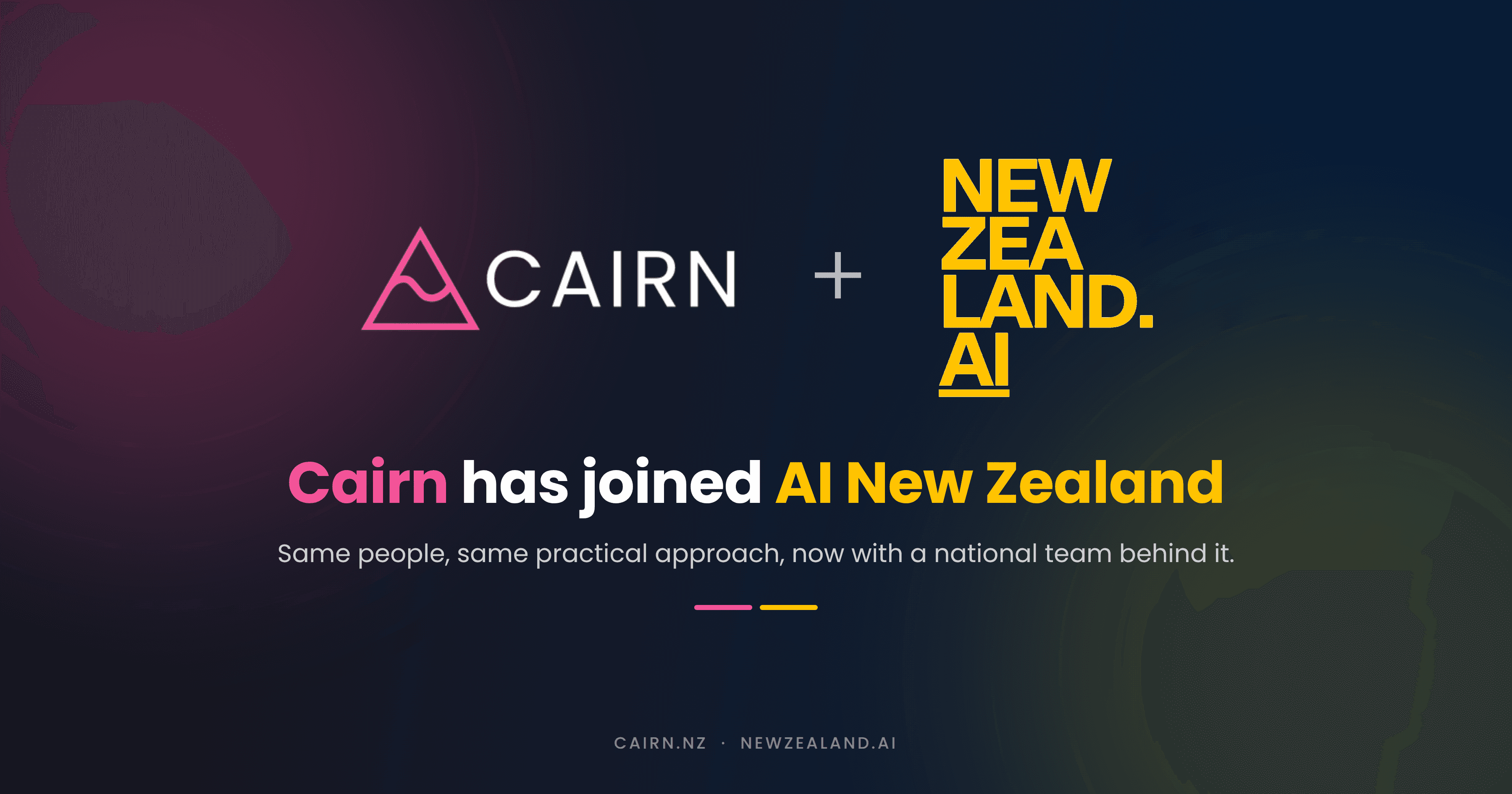
I've been thinking about that a lot since 1 September, which is the day Justin Flitter and I signed the paperwork that brought Cairn and AI New Zealand together. The short version is on the site: I'm now a Director and Chief Technology Officer of AI New Zealand, Cairn is a 50% shareholder, and Cairn's clients are now AI New Zealand clients. This post is the longer version.
The solo founder trap
I started Cairn because I wanted to do the work my own way. Practical AI that people could use on a Monday, not a slide deck. People, process and technology, in that order. Nobody reselling anything. It worked, and I'm proud of it.
It also had a ceiling I could feel but didn't want to name. When you're one person, every yes is a no to something else, and the workload is bumpy: flat out for three weeks, then twiddling my thumbs, then flat out again. I'd finish a Copilot training in Invercargill, drive home, and open an inbox full of good work I was going to have to turn down or squeeze into a week that was already full. The clients who needed the most help were the ones with the most moving parts, and I was one part.
The uncomfortable bit is that the solo model rewards you for that. You're busy, the work is good, the reviews are good, and being the person everyone calls feels like the point. Turns out it's the trap.
Two businesses, one trail
Justin and I met at the NZ AI Roadshow when it came through Dunedin in 2024. He'd been building AI New Zealand since 2017, mostly on his own too, with a family of contractors and partners around him. We started working together almost straight away: his clients, my Copilot programmes, then the courses, then a lot more.
📡 By the middle of last year I noticed something. I could still tell you which of us a piece of work belonged to, but more and more of it was being done as a team. We were already one team with two names and two invoices.
In January we started talking about what a real partnership would look like. Not a referral arrangement, an actual merger with shares and directors and a lawyer who'd seen it all before. It took eight months. Some of those conversations were hard, and they were meant to be. If you're going to hand half of something you built to someone, you'd better have asked every awkward question first. We did.
What changes, and what doesn't
The name stays. Cairn keeps its shareholding, this website, the podcast and this blog. The principles I wrote up on the Why Cairn page haven't moved a millimetre.
What changes is what's behind me when I walk into a room. AI New Zealand has advisors, trainers and engineers in Auckland, New Plymouth and Christchurch, an academy with thousands of members, the free AI Benchmark that used to be Cairn Compass, and the AI Operating System for organisations that want AI running as a governed, managed thing rather than a set of experiments. Everything I was doing alone now has depth. If a client needs a process analyst or an engineer, I don't have to be a worse version of one.
For the people I've been working with, the day to day looks the same. Same person, same conversations, still Dunedin. The paperwork just says AI New Zealand now, and the services live there.
Two weeks in
The response has been the best part. Clients on both sides, AI New Zealand's and Cairn's, have gone out of their way to tell us they think it's a good move and that they're keen to see what we build together. It's early days, but the feedback on the increasingly joint approach has kept coming, and none of it has been "why did you change things".
Building out a national team, and the capability that comes with it, is the bit I'm most looking forward to. It's better for us, and it's better for the people we work with.
The bit I didn't expect
I thought the hard part would be giving something up. It wasn't. The hard part was admitting that "I'll just do it myself" had stopped being a strength about a year before I was willing to say so.
Justin put it well in his announcement: it's not just him anymore, and that's good. From my side it reads the same way. It's not just me anymore either.
Crew at the aid station. That's the whole story.
If you want to talk about any of it, connect@cairn.nz still reaches me, and so does ben@newzealand.ai.