AI Training in New Zealand: What to Expect in 2026
In short. Most New Zealand employees already use AI at work and fewer than a quarter of us have had any training in it. A structured online course runs from around $150 to $500 a person; an in house session for a room of 20 to 25 from around $3,000 to $6,000, ex GST. In person beats online for the core sessions. Train the leaders first, measure one task before and after, and ask any provider how many facilitated hours are in the quote.
A man sat down at the back of an AI adoption workshop I ran earlier this year. Before I'd said a word he told me he didn't do AI. He'd written it off on the strength of what he'd seen online: the dancing cats and the doom. Ninety minutes later he left with ChatGPT on his phone and three things to try on Monday. Last week, in another session, someone told me a spreadsheet job that normally ate two and a half months of her year had taken less than an hour.
I've trained more than 2,000 seats across several hundred New Zealand organisations in the past two years, and those two moments are the market in miniature. Most people are already using AI at work. Very few have been shown how. This piece is about what that gap looks like, what closing it costs, and what to check before you spend anything. I sell training in this market, so I've written the pricing section so you can check me rather than trust me.
What does the New Zealand data say?
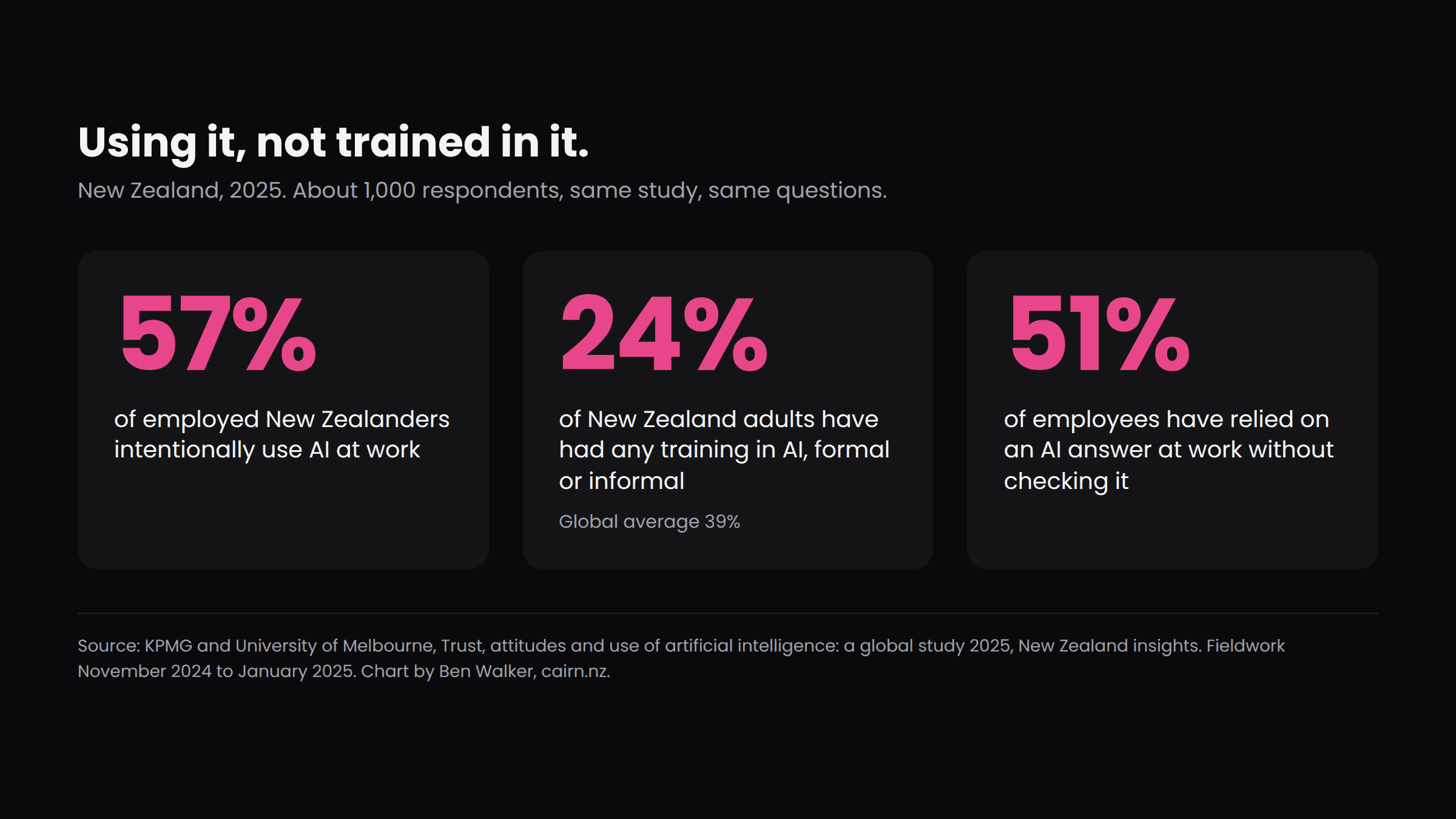
The best single source is the University of Melbourne and KPMG study published in 2025, which asked about a thousand New Zealanders the same questions it asked in 46 other countries. Three of its findings belong on the same page, and they're the three at the top of this post.
More than half of people in work are using the tools. Fewer than a quarter of adults have been trained in them. Half of employees have taken an AI answer on trust at least once. That last one isn't a fringe behaviour. It's the median employee.
I think of this as the unchecked half. Not people refusing AI, and not people misusing it deliberately. People handed a powerful tool with no instruction, doing what anyone would do, which is use it and hope.
Is adoption really as high as the headlines say?
It depends who you count. The figure that gets quoted most, 91 percent of New Zealand organisations using AI, comes from Datacom's annual survey of leaders at organisations with 100 or more staff. Those are our largest employers, and they're a sliver of the country. Almost all New Zealand enterprises have fewer than 20 people, and among them the picture is very different.
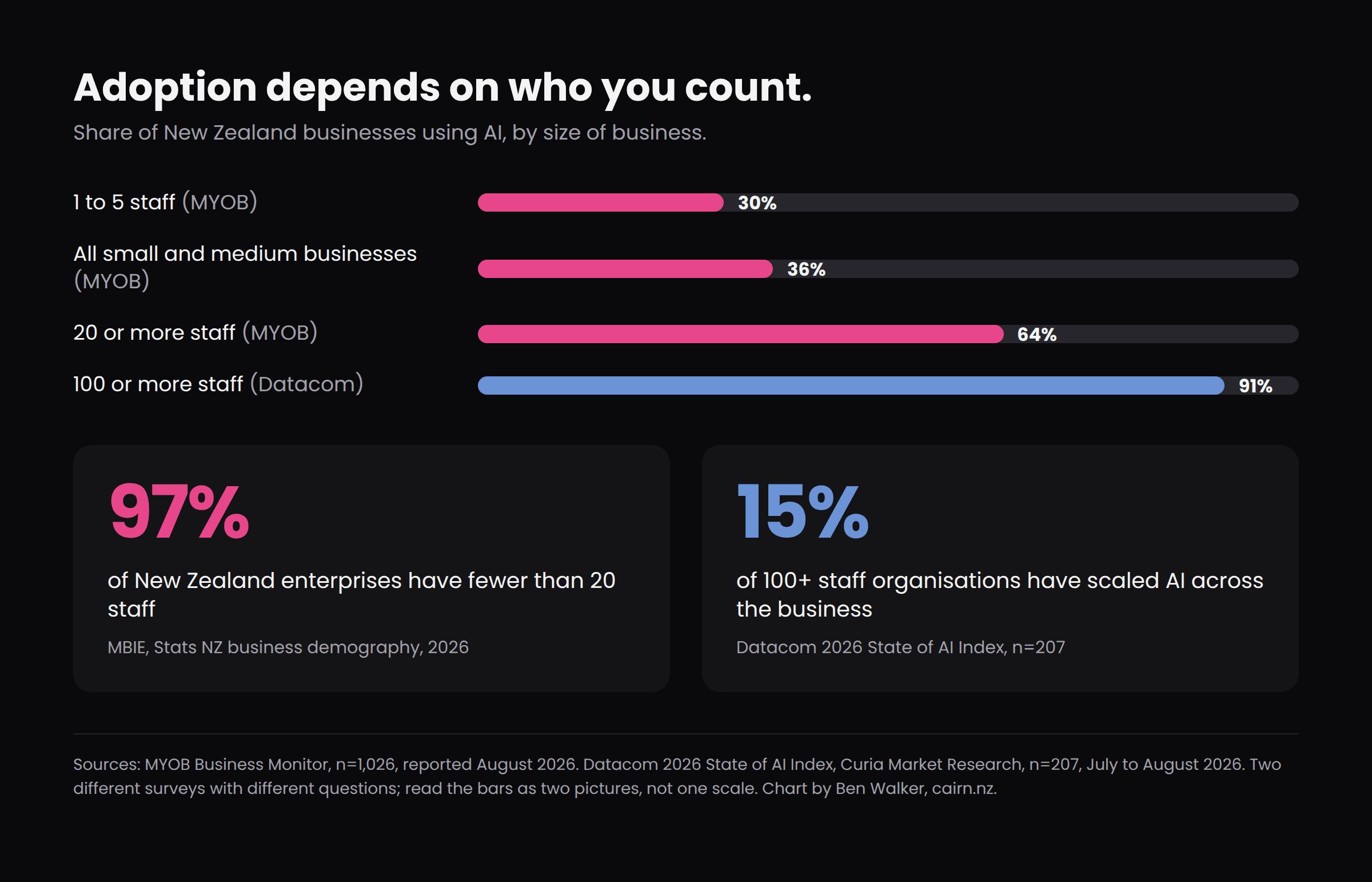
Even at the top end, adoption is wide and thin. Most large organisations are still in pilots or single department use. And when PwC asked New Zealand chief executives earlier this year, most said their culture and technology were ready for AI, and nearly eight in ten said it had made little or no difference to their organisation so far. I read that as a finding about how shallowly AI is being used, not about the technology.
MBIE's own research into small businesses reached the plainest conclusion of all: awareness isn't the barrier, confidence and capability are. Nobody in New Zealand needs telling that AI exists. They need someone to sit beside them while they use it.
How does New Zealand compare with the UK?
The KPMG study asked the UK the same questions in the same window, which makes this one of the few country comparisons that is fair.
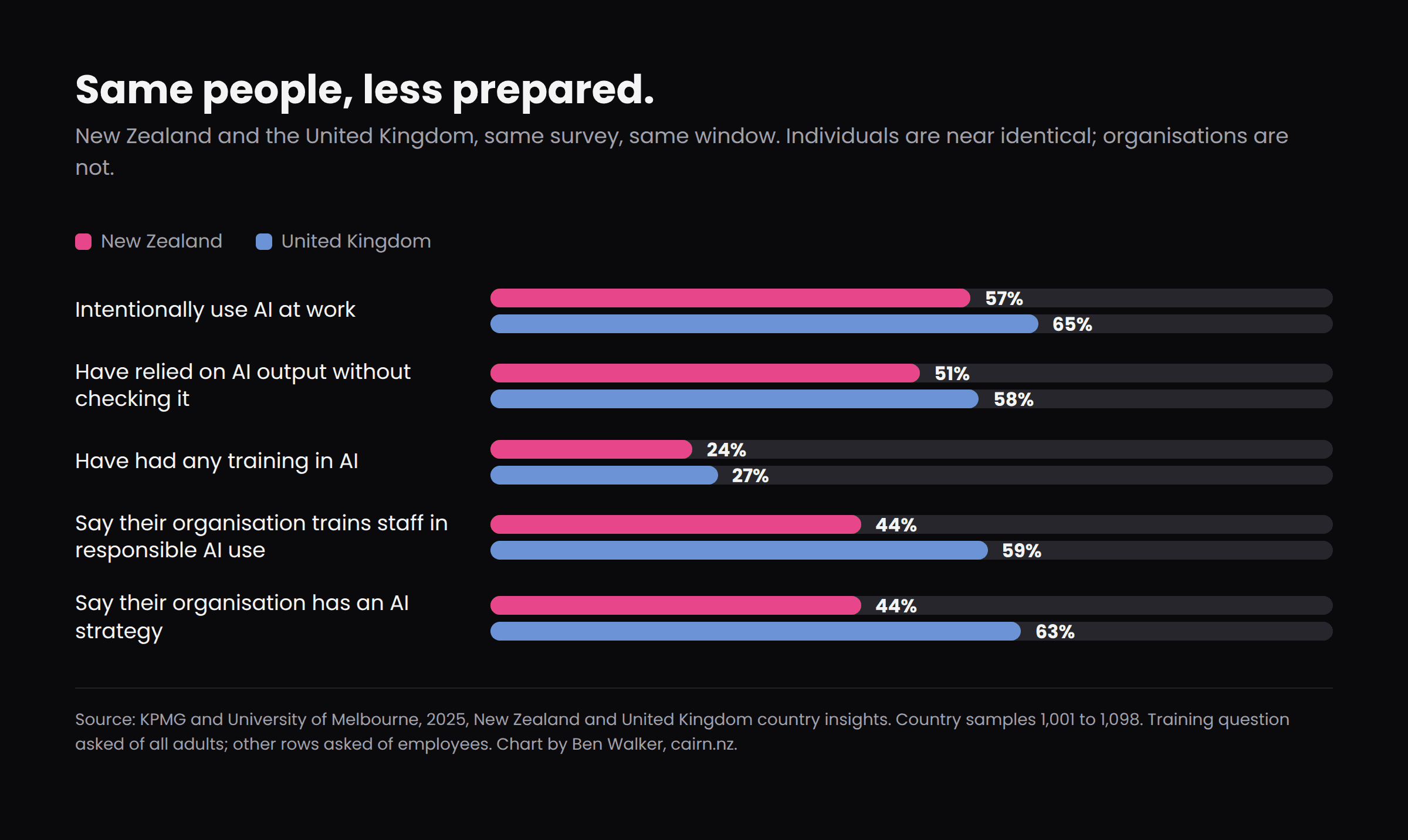
The individuals are near identical. Where the two countries part is the organisation around them. UK employees are markedly more likely to say their employer trains them in responsible AI use and has a strategy for it. The UK also uses AI more and makes more mistakes with it, so being further along hasn't made it safer. But the gap that matters for a New Zealand leader is the organisational one, because that's the part you control.
The UK has one other thing we don't. Since January 2026 every UK adult has had access to free, government backed AI skills courses. New Zealand's Digital Boost programme closed in 2024, and the government's replacement in this space is a $765,000 pilot for a minimum of 51 businesses. If you're waiting for the state to build your team's AI capability, you'll wait a long time.
What does an AI training engagement look like?
Most of what I run falls into three shapes, and the market broadly does the same.
The first is a leadership session: two to three hours, in person, with the executive team or the board, working through what AI is doing inside their own organisation, what the risks are, and what they want to be true in twelve months. It goes first because nobody below the leadership team will be given room to try until the people at the top can tell a real result from a plausible one.
The second is team training in tiers. A basic session for people who haven't started, a skills session for people who use AI for the small stuff and want to do more, and an advanced session for the people who'll become the organisation's internal experts. Each runs around 90 minutes, in a room of up to about 25. The trainer works through clear examples everyone can relate to, and every attendee follows along in their own environment, on their own licence, so what they learn on the day is what they'll have on Monday. There's a gap between tiers so people come back with what worked and what didn't. Done as one long afternoon, people retain a tenth of it.
The third is online reinforcement: a structured, current, self paced course with a certificate at the end, for new starters and the people who missed the day. It's the safety net, not the main event.
How much does AI training cost in New Zealand?
Published prices are scarce because the large integrators quote bespoke. The professional bodies and universities publish theirs, and from those and the market I work in, here is what I'd expect to pay. These are my own ranges, not survey data, my pricing sits inside them, and everything is ex GST.
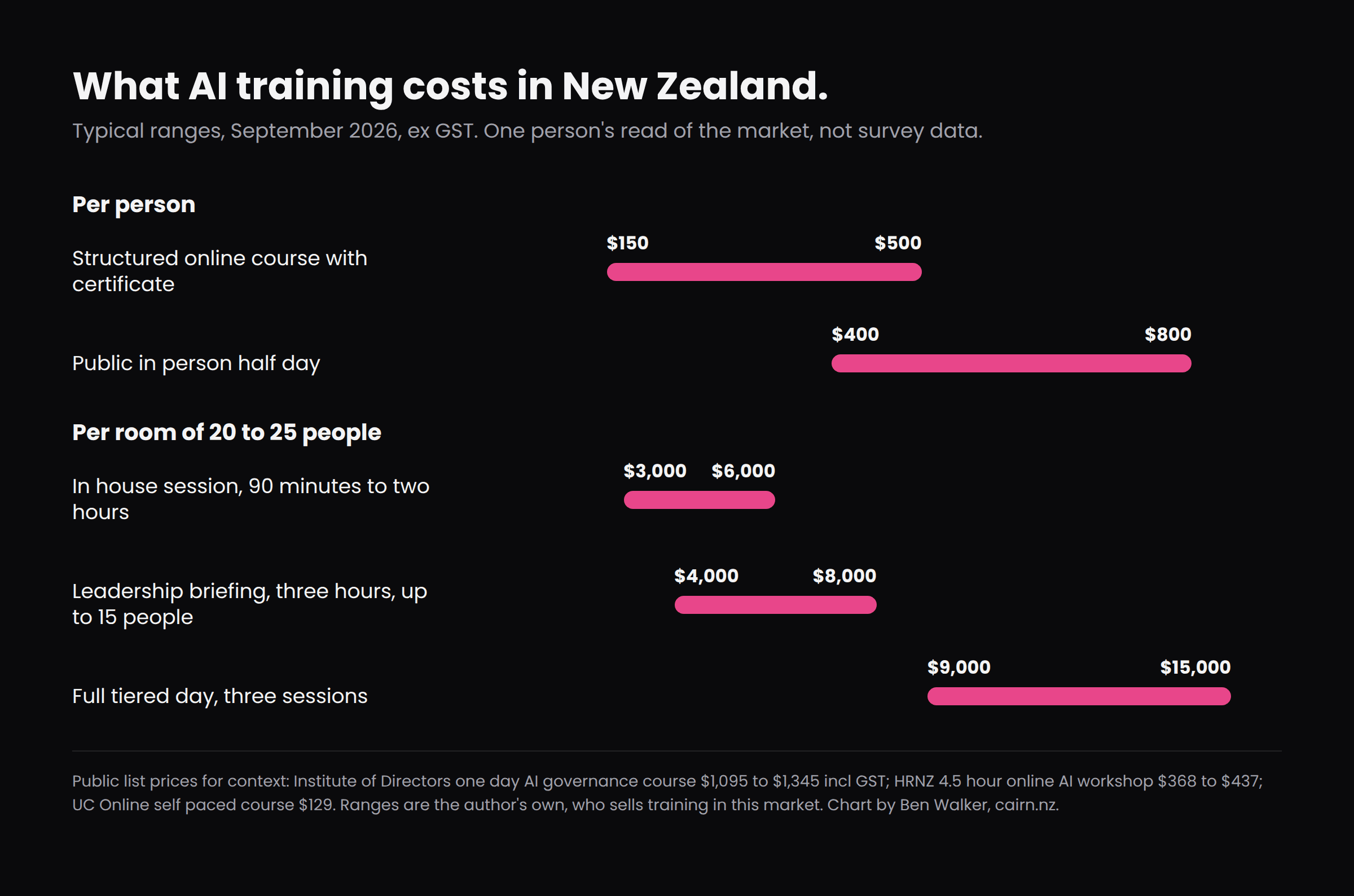
Within each range you'll find a spread of providers. A higher price is not evidence of better training any more than a lower one is evidence of worse. The questions further down tell you more than the number on the quote.
Why does in person beat online for AI training?
About 80 percent of the seats I've trained have been in a room, and the difference isn't subtle. Someone can lean over and fix the sign in that has stopped a person for three weeks. More often than you'd think, about one person in thirty in my experience, they turn out to be using the wrong tool altogether: the free consumer Copilot rather than the Microsoft 365 Copilot their Business Premium licence gives them. That's a data problem as much as a capability one, and nobody spots it on a video call. People ask the question they'd never type into a chat window, the one they think is silly, and find half the room had it too. Everyone watches the same screen and sees the same thing go right and go wrong. The content bends toward the room, so a council team spends its time on official information requests and a legal team on discovery. The side questions are usually the most valuable ten minutes of the day. None of that survives a self paced video.
The research points the same way. The large international surveys find that people who get a few hours of proper training use AI far more, and that most of the difference in results between organisations comes from the organisation, not the individual. A Danish study of 25,000 workers found the biggest time savings where the tools arrived with training and visible encouragement from managers, and, worth saying plainly, no measurable effect on pay or hours anywhere. The tool is the cheap part. The surroundings decide the return.
What should give you pause?
A quote with no hours in it. If you can't tell how many hours of facilitated time you're buying and how many people share them, you can't compare it with anything.
Watching, not doing. Good examples on the trainer's screen are the point, as long as they're ones everyone can relate to and replicate. If your people can't follow along in their own environment during the session, they learn what the tool can do in general and not what it can do for them on Tuesday.
A deck dated March. Copilot and Claude change monthly. Ask when the material was last updated and who updates it.
No leadership session. Training the team while the executive stays out of the room produces enthusiastic staff and no permission to change anything.
Nothing measured afterwards. If the provider can't tell you what they'll measure, you won't know whether it worked, and neither will they.
What I'd suggest
Find out where you actually are. Ask your people, anonymously, whether they use AI at work, whether they've had training, and whether they check the output. Expect the answers to look like the national figures.
Write the rules before the training, not after. A one page acceptable use policy and a position on which tools can see which data. The Privacy Commissioner's guidance is the starting point.
Start with the leadership team, in person, with your own use cases on the table. Then run the whole team through tiers in rooms small enough for questions, with a few weeks between them. Back it with an online path for the people who miss the day.
And measure something. Hours on one repeatable task before and after is enough. If you can't name a task, you're not ready to buy training yet, and that's a useful thing to know.
The tools are already in your organisation. The only question left is whether the people using them have been shown how.
I'm Chief Technology Officer of AI New Zealand, which sells the kind of training this piece describes, so read the pricing section with that in mind. The delivery figures are my own records to September 2026 and aren't independently audited. The full evidence paper this piece draws on, with 36 sources, is available on request: ben@newzealand.ai.
Frequently asked questions
- How much does AI training cost in New Zealand?
- Structured online courses run from around $150 to $500 per person. In house sessions for a room of 20 to 25 run from around $3,000 to $6,000 for 90 minutes to two hours, and a full tiered day from $9,000 to $15,000. Leadership briefings sit between $4,000 and $8,000. All ex GST, as at September 2026.
- What share of New Zealanders have had AI training?
- About one in four adults, against roughly four in ten globally, according to the University of Melbourne and KPMG's 2025 study of 47 countries.
- Is online or in person AI training better?
- In person for the core sessions, online for reinforcement. In person lets people fix technical blockers, ask the questions they won't type, and work in their own environment on examples they can replicate.
- Is there free AI training in New Zealand?
- Microsoft, Google and LinkedIn all offer free online courses. There is no government run programme; Digital Boost closed in 2024. Free courses teach what the tools are. They don't teach your team to use them on your work under your privacy obligations.